
I am a contemporary, intermedial artists whose work emerges at the intersections of choreography and dance, sound and music, light and photography, video and text production, and popular culture. Through these media, my collaborators and I place historical reference, trope, gesture, and critique in conversation to interrogate our place in social systems and in the dance field. My work is unnervingly humorous, mentally and physically challenging, and inexorably queer.
I see the world around me as a complex decision matrix, one in which a series of events has cascaded to make my existence what it is.
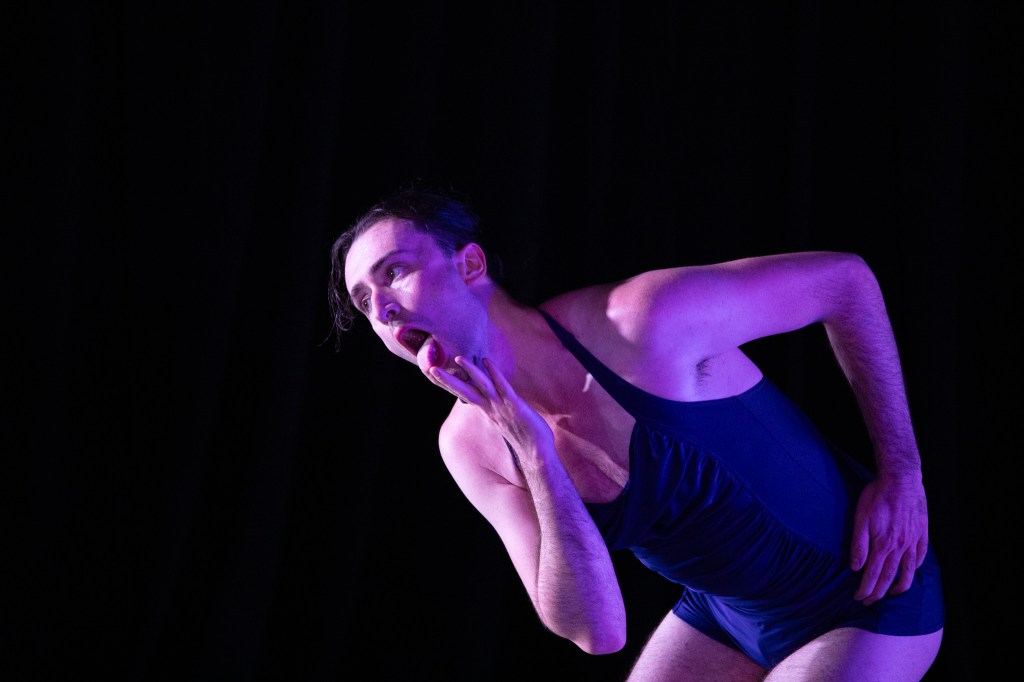
I was born to an Iranian father and an “American” mother. My older sisters and I started dance class together, but for me, tap, studio jazz, and ballet provided an outlet for my neurodivergence and queerness to bud. I spent my early childhood moving, until our family settled in a small Tennessee town where the limestone quarries, cows, and whiskey distilleries drastically outnumbered visible queer people. My relationship with burgeoning queerness grew as an extension of my love-hate relationship with the Southern US. I became small, quiet, obedient, and wound taught — waiting for release. I’ve spent most of my artmaking years in the Midwestern US, where a sudden lack of mountains and rivers and lakes—a certain dampened silence at a blizzardy dusk, or, a seemingly endless expanse of flatness glimpsed from the balcony of an ex-lovers high rise—dominates my consciousness.
My affinity for living in inhospitable places has made me vigilant as to how I am seen and where. I couple this trans experience with contemporary releasing techniques to unwind the tensions of my reality. Now, my work injects me into places or placelessnesses where I desire to see myself: an alternate reality, a music video, the future. Dance is my medicine. I dance myself into existence and aim to help others to do the same.

I have toured my solo choreographic work across the US and am currently performing with Sara Hook Dances. I have had the great privilege of creating musical scores to accompany the works of artists such as Jennifer Monson (in collaboration with Joy Yang, Ph.D.), Roxane D’Orleans-Juste, Jacob Mark Henss, and Anna Sapozhnikov. My music productions can also be found on streaming services under the name Elliot Reza. I use digital manipulations like Photoshop, video and sound editing softwares, and autotune to hyperbolize reality and to make tangible the sensation of space.
I believe in the power of dance as a transformative mode of knowing the intricate, delicate complexities of ourselves, our environments, and our histories. I am obsessed with the interwoven development of dance, music, performance, and society in the post-Industrial Revolution US. In tap and modern dance; jazz, rock and roll, hip hop, and pop music; and theatre and dance performance, we can trace social and political inequity and situate a longevity of Black, queer, and femme excellence. Choreography becomes the vehicle through which I attempt to make visible those invisible threads that have woven us into who we are. This “open-source choreography” exists in several iterations. Jack and Diane is an evolving solo performance interrogating the façade of the American Dream through an examination of my maternal and paternal, danced, and cultural lineages. It was most recently mounted at Links Hall (Chicago, IL) in 2024. Similarly, Jack be nimble, created in collaboration with Jacob Henss (St. Louis-based performer and producer); Jill of all Trades, created in collaboration with Rachel Rizzuto (performer and writer for Dance Magazine); and acreage, created in collaboration with Alfonso Cervera (contemporary and ballet folklórico performer and choreographer) all take interrelationship as a primary focus, generating performance material in the space between our creative efforts. I believe that community is the bedrock of artistry, and activate collaboration, curation, and resource-sharing as the primary genesis for my work. My 2021 dance film MASCCHAOS, created in collaboration with 29 femme and nonbinary US artists, also explores these themes directly. Seemingly infinite copies of my queer dancing body melt and whip through complex improvised sequences, never quite in unison but always attempting to align: they are foiled by jump-cut editing. Repetition works itself into visible rhythms until exhausted into new physical tangents, and all the while spacious sound (supplemented by a queer narration) pulse dramatically through surround sound speakers.
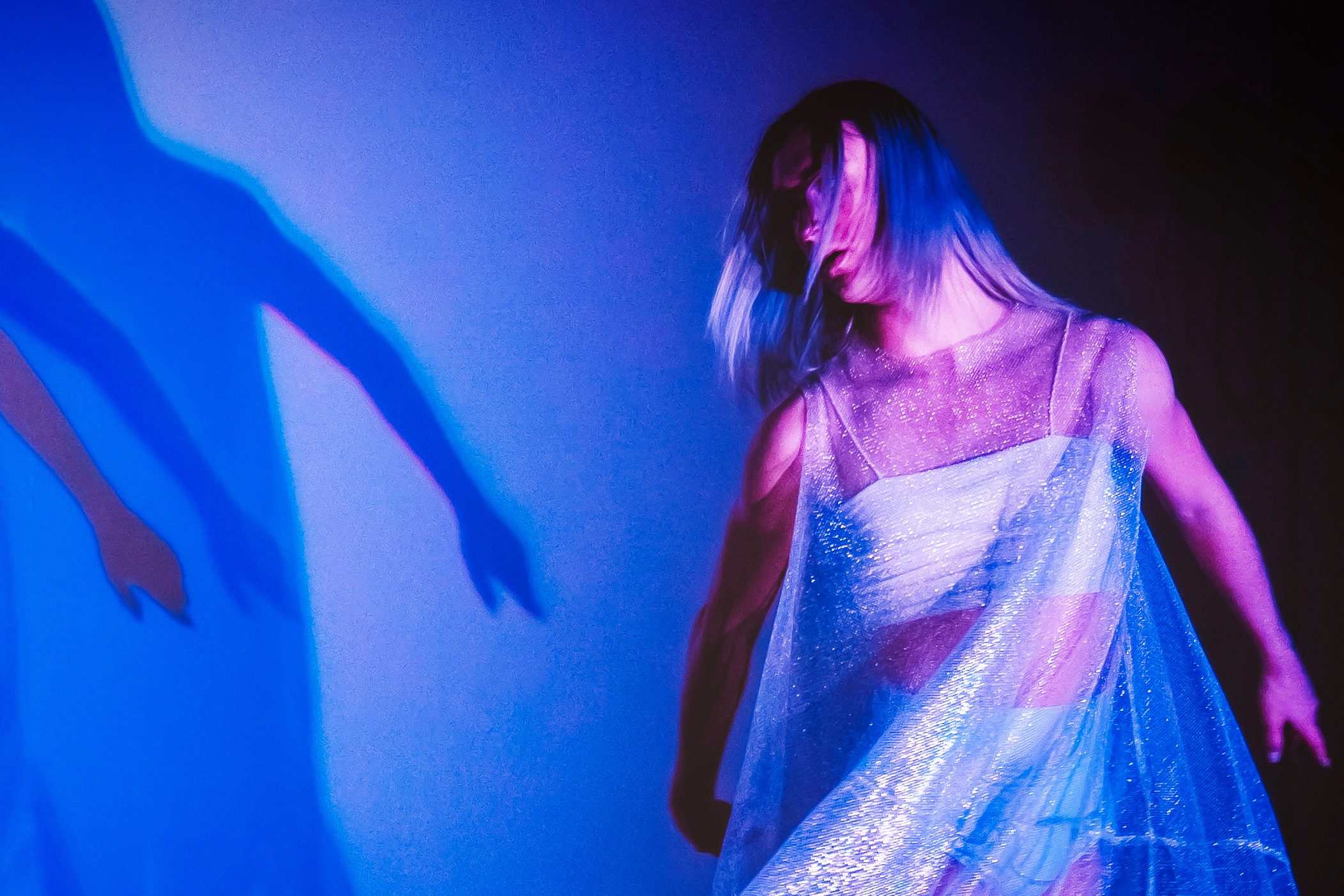
My current project, HOOK. LINE. SINKER. is a new contemporary dance performance. Over the course of the next 2 years, I will devise a choreographic work with professional artistic collaborators including five professional dancers, a dramaturg, lighting and costume designers, and sound composers. Through this dissemination of artistic and embodied knowledge, I aim to offer cultural critique and encourage viewers to reflect on their global positionality. HOOK. LINE. SINKER. positions the hook from popular music as a choreographic conceit. In popular music, this hook represents a seemingly innocuous poetic inscription of our cultural context. Through the digital transformation of music video choreography and, more recently, TikTok challenges, dance and popular music retain a subversive link. This connection has persisted through a pandemic and the resulting social isolation. However, the hooks (and associated dances) of popular songs are increasingly similar, driving a perceived homogenization of Western cultural products. I attribute this, in part, to capitalist forces: some artists align sales success with artistic merit, and taste drives production. Through this performance project, my collaborators and I will examine the implications of producing art within and against a capitalist system, responding to and generating specific representations of American culture, and how embodied performance specifically intervenes alongside sonic expressions to make manifest the political implications of contemporary art.
 Elliot Reza